
Ultra High Performance Concrete (UHPC): Revolution in Modern Construction
Overview
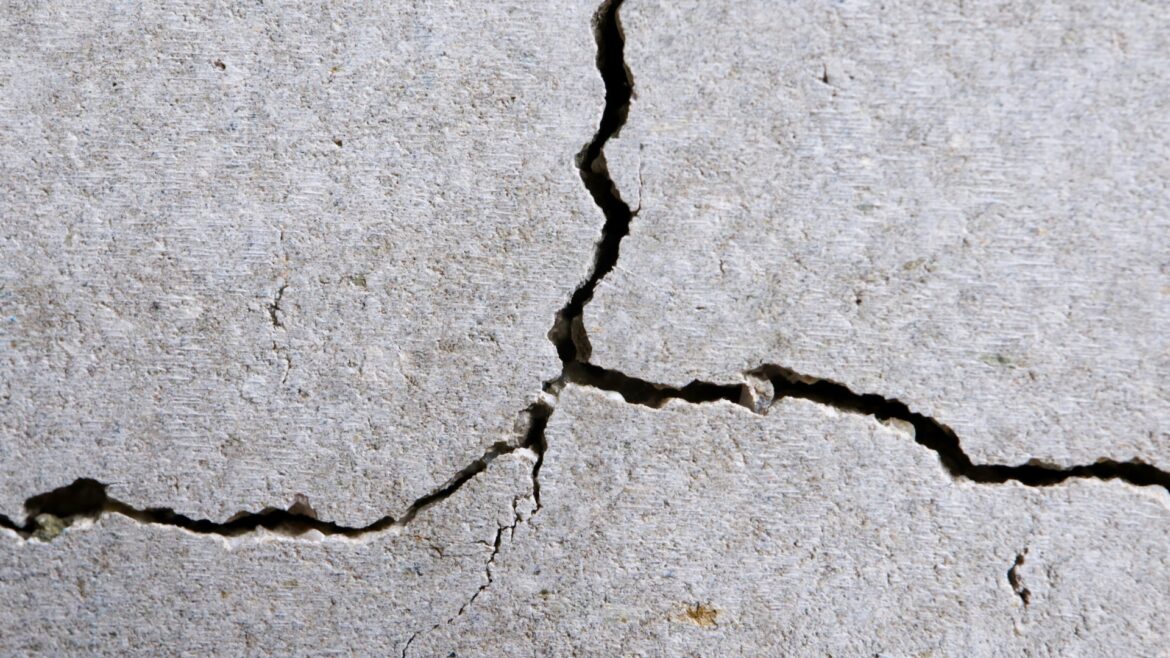
In an era when the construction industry faces rigorous demands to reduce carbon footprint, accelerate construction timelines, and dramatically extend structure service life, conventional building materials are slowly reaching their technological limits. Traditional reinforced concrete (RC), although the dominant material of the 20th century, faces inherent durability problems – primarily corrosion of reinforcement caused by chloride penetration and carbonation.
Modern materials science’s answer to these challenges is Ultra-High Performance Concrete (UHPC). UHPC doesn’t just represent a step forward in strength; it defines a completely new mechanical and structural paradigm that erases the traditional boundaries between concrete and steel structures.
What Exactly Is UHPC? Reconstruction at the Nano-Level
While conventional high-strength concretes (HPC) rely on reducing the water-cement ratio and optimizing standard aggregate fractions, UHPC represents a complete reconstruction of the material’s internal topology.
According to the definition of leading professional associations such as ACI (American Concrete Institute) and fib (Fédération internationale du béton), UHPC is a cementitious composite material characterized by:
- UHPC have a characteristic compressive strength exceeding 150 MPa, although values between 120 and 180 MPa are also accepted depending on the applicable national recommendations.
- Tensile strength with clear ductile behavior (strain-hardening).
- Exceptional durability due to a discontinuous pore system.
Eliminating the Weak Link: The ITZ Zone
In ordinary concrete, the weakest point is the Interfacial Transition Zone (ITZ), a porous zone at the contact between cement paste and coarse aggregate (gravel). Under load, microcracks always generate and propagate through the ITZ.
UHPC radically solves this problem by completely eliminating coarse aggregate. The maximum particle size in a UHPC mix rarely exceeds 0.5 mm to 0.6 mm. Using particle-packing mathematical models (such as the Modified Andreasen & Andersen model), the matrix is composed of strictly graded quartz sand, high-grade portland cement, reactive silica fume, and nano-silica. The result is an extremely homogeneous and dense microstructure.
Composite Mechanics: How “Brittle” Becomes “Ductile”
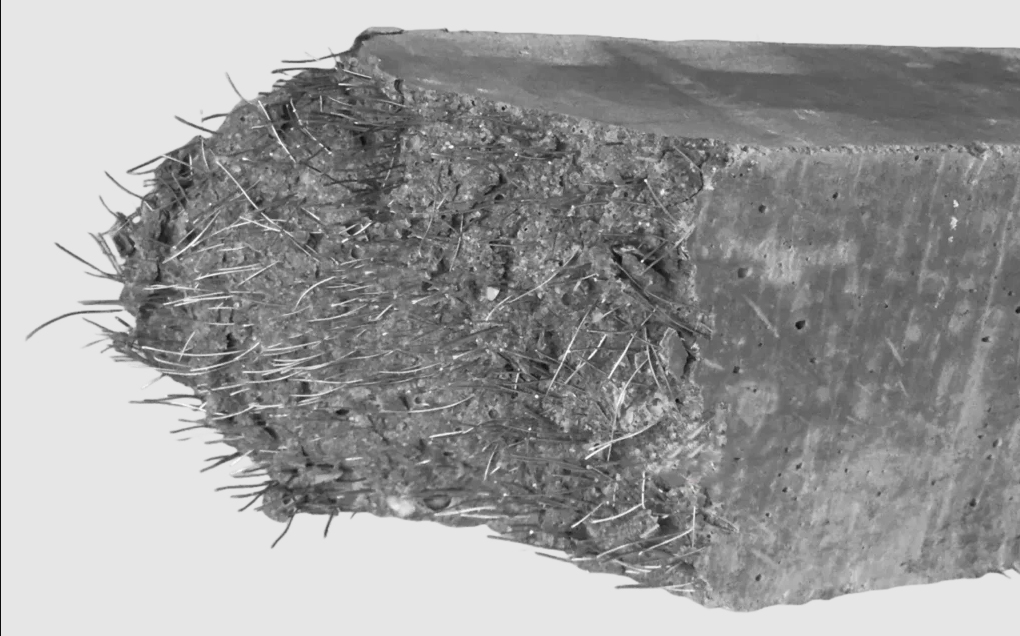
If we produced a UHPC matrix without additional elements, we would get a material of extreme compressive strength, but with a frighteningly brittle failure. To achieve toughness, the matrix is reinforced with discrete microfibers (most often steel, with high tensile strength > 2000 MPa), at a volume fraction of 1.5% to 3.0% (approx. 120–240 kg/m³).
The Strain-Hardening Phenomenon
Unlike ordinary concrete, whose tensile strength is completely disregarded in ultimate limit state (ULS) calculations, UHPC has an internal crack-bridging mechanism. When tensile stress exceeds the strength of the matrix itself, the fibers take over the load. Depending on the mix type, the material enters a strain-hardening phase – capable of accepting greater tensile stress while generating a multitude of barely visible microcracks (less than 0.05 mm wide), instead of a single critical macrocrack.
Implications for Design and Reinforcement Detailing
For designers and engineers in the office, UHPC opens doors that were closed until yesterday.
Extreme Slenderness and Weight Reduction
Thanks to enormous compressive and residual tensile capacity, the cross-sections of elements can be reduced by 60% to 70% compared to conventional reinforced concrete. This directly leads to a drastic reduction in the structure’s self-weight, lower seismic forces, and easier transport of precast elements.
Micro Anchorage Lengths (Bond Strength)
Because of the ultra-dense matrix, the bond strength between deformed reinforcement bars and UHPC is superior. Traditional anchorage lengths of 30φ to 50φ become a thing of the past here. Experiments verified by the FHWA (Federal Highway Administration) show that the full yield strength of a steel bar develops over a length of just 8φ to 12φ.
- Example: For a φ16 bar, the anchorage length in UHPC is barely 160 mm. This eliminates the need for complicated 90° or 180° hooks and allows the resolution of the densest reinforcement nodes with incredible ease.
Revolution in Durability: A Service Life of 100+ Years
Durability is the area where this material makes the greatest economic and ecological difference over the long term (Life-Cycle Cost Analysis – LCCA).
- Water permeability: Almost immeasurable. The discontinuous capillary pore system prevents water movement through the material.
- Resistance to chlorides and corrosion: The chloride ion diffusion coefficient in UHPC is up to 100 times lower than in standard C30/37 concrete. Reinforcement within UHPC elements is permanently protected, even in aggressive environments such as coastal areas or bridges exposed to deicing salts.
- Freeze-thaw resistance: After hundreds of freeze-thaw cycles, UHPC retains 100% of its dynamic modulus of elasticity.
The Most Important Engineering Applications in Practice
Where does UHPC bring the greatest value, and where is it most applied today?
Joints of Precast Elements (Prefabricated Bridge Elements)
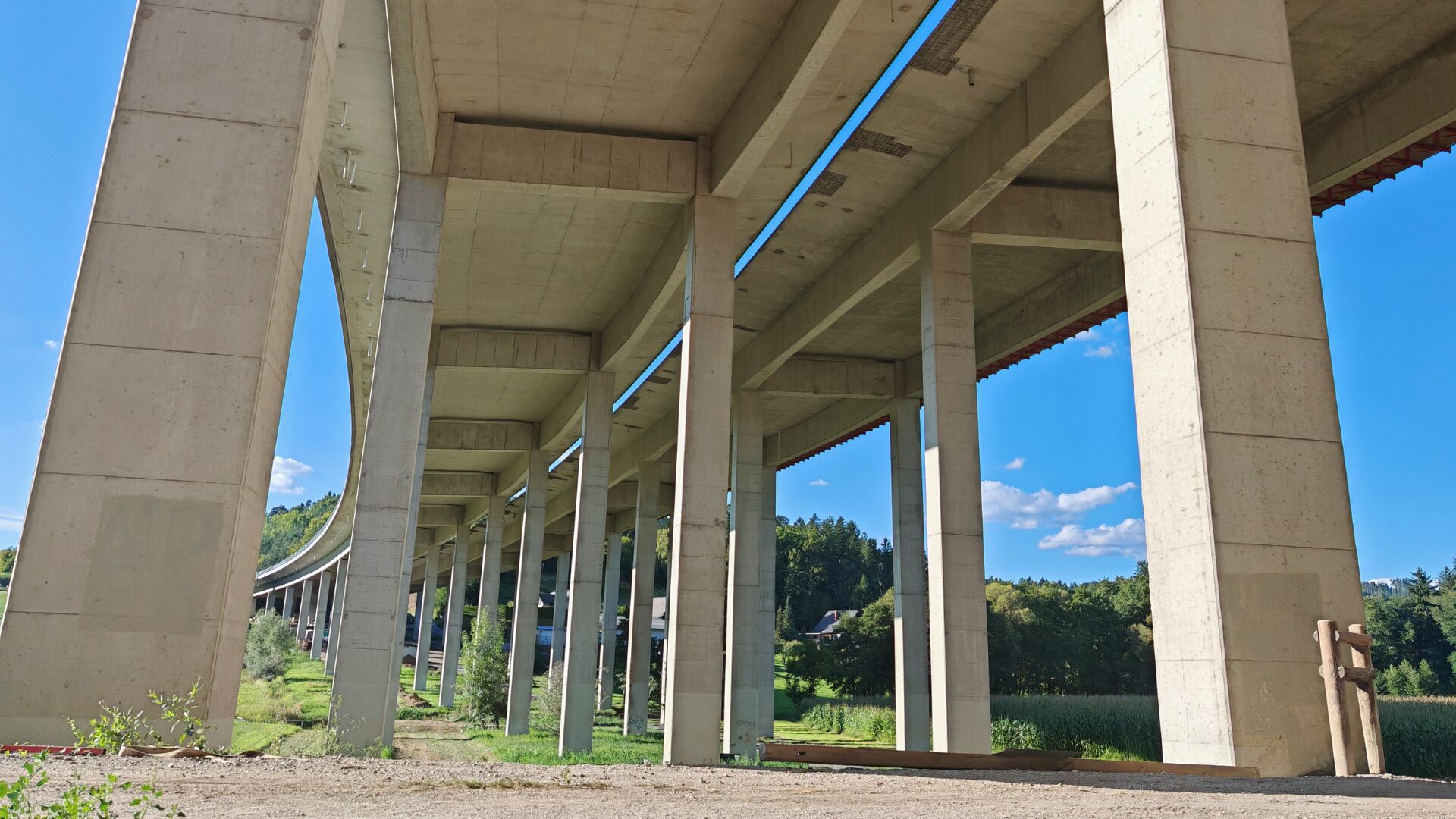
In bridge construction, the biggest challenge is the joints between precast girders or slabs. By using UHPC to fill the joints, the space between elements is reduced to a minimum (only 15-20 cm). Because of the short anchorage length, the straight bars protruding from the precast elements simply overlap within that narrow space. The result is a monolithic, durable, and watertight joint that eliminates the traditional leaking problems on bridges.
Repair and Strengthening of Existing Structures (Retrofitting)
Instead of demolishing or massively re-casting damaged columns and beams, a thin layer of UHPC (the so-called overlay, only 25-50 mm thick) is applied. This “skin” layer acts as waterproofing, prevents further penetration of CO₂ and chlorides, and at the same time drastically increases the element’s shear and bending capacity.
Facade Panels and Architectural Elements
Aesthetically, UHPC’s rheological properties (high flowability and self-consolidating nature) allow precise reproduction of the most complex formwork geometries and textures. Facade panels can be extremely thin (20-30 mm) and of large spans, without the risk of brittle failure due to wind or seismic action.
Challenges and How to Overcome Them
Despite its revolutionary properties, implementing UHPC in everyday engineering practice faces certain challenges that the profession must successfully address:
- High initial material cost: A cubic meter of UHPC is significantly more expensive than ordinary concrete due to the high cement content, special admixtures, and steel fibers. However, engineers must look at the overall project economics: less concrete volume = less reinforcement = lighter foundations = dramatically lower maintenance costs over 100 years.
- Autogenous shrinkage: Because of the low water-cement ratio (w/c ≈ 0.15 – 0.18), UHPC is prone to early autogenous shrinkage due to chemical self-desiccation. Early and rigorous curing by wet curing or covering with impermeable membranes immediately after casting is imperative.
- Fiber orientation effect: During casting, microfibers orient themselves along the direction of concrete flow. If the concrete flows poorly or is poured from multiple locations without a plan, poor fiber orientation can occur at cold joint locations, which directly weakens tensile strength. The designer and contractor must always work closely together through a precise casting plan.
Conclusion
Ultra-high performance concrete is no longer an experimental material reserved only for elite institutes and laboratories. It has become a commercially viable, technically superior solution that redefines sustainability and durability in construction.
The transition to UHPC requires us, as engineers, to abandon old calculation patterns where concrete is just “a mass that carries compression,” and to start thinking of concrete as a smart, ductile, and high-tech composite.
The future of infrastructure belongs to slender, durable, and sustainable structures – and UHPC is the key tool for creating that future.
FAQ
Q: Is UHPC just a stronger version of high-strength concrete (HPC)?
A: No. HPC is conventional concrete optimized through a lower water-cement ratio and standard aggregate gradation. Ultra-High Performance Concrete (UHPC) removes coarse aggregate entirely and rebuilds the matrix at particle-packing level, which is what enables its tensile strain-hardening behavior, a mechanism HPC does not have.
Q: Does UHPC eliminate the need for reinforcing bars?
A: Steel microfibers control crack width and give the matrix ductility, but conventional deformed reinforcing bars are still used for global structural reinforcement, sized and detailed with shorter lap splice lengths than in conventional concrete.
Q: Why is UHPC not used on every project if it performs this much better?
A: Primarily cost and workflow maturity. Higher material cost per cubic meter, sensitivity to autogenous shrinkage, and the need for precise casting sequencing all require closer design-construction coordination than conventional concrete — which is why adoption is currently concentrated in bridge joints, retrofits, and facade panels where the performance gain justifies that coordination.
Q: Does UHPC need special curing compared to normal concrete?
A: Yes. Because of its low water-cement ratio, Ultra-High Performance Concrete (UHPC) is more prone to autogenous shrinkage in the first hours after casting, so early and rigorous curing (wet curing or sealed membranes) is treated as mandatory, not optional.
About Us
NS Drafter specializes in BIM modeling, rebar detailing, steel detailing, and construction documentation for residential, commercial, and complex infrastructure projects. Our teams work across Revit, AutoCAD (ArmCAD), Tekla, and Allplan, delivering models and plans depending on project requirements.
Ready to improve your BIM modeling workflow or start your first fully modeled project? Get in touch and let’s talk about where to start.
