

Successful Construction Case Study I Deiker Höfe Case Study
Overview
When a residential development spans 55,000 m² across three building zones and eight buildings tied together by a single underground garage, the detailing workload stops being a deliverable and becomes an operational challenge.
Deiker Höfe in Düsseldorf is exactly that kind of project, and the kind where formwork and reinforcement detailing have to be planned as a system.
This case study walks through how the NS Drafter team produced the formwork and reinforcement documentation for Deiker Höfe, what the structural scope looked like at element level, and which decisions kept 12,500 working hours on schedule across a 9-month delivery window.

Project Overview
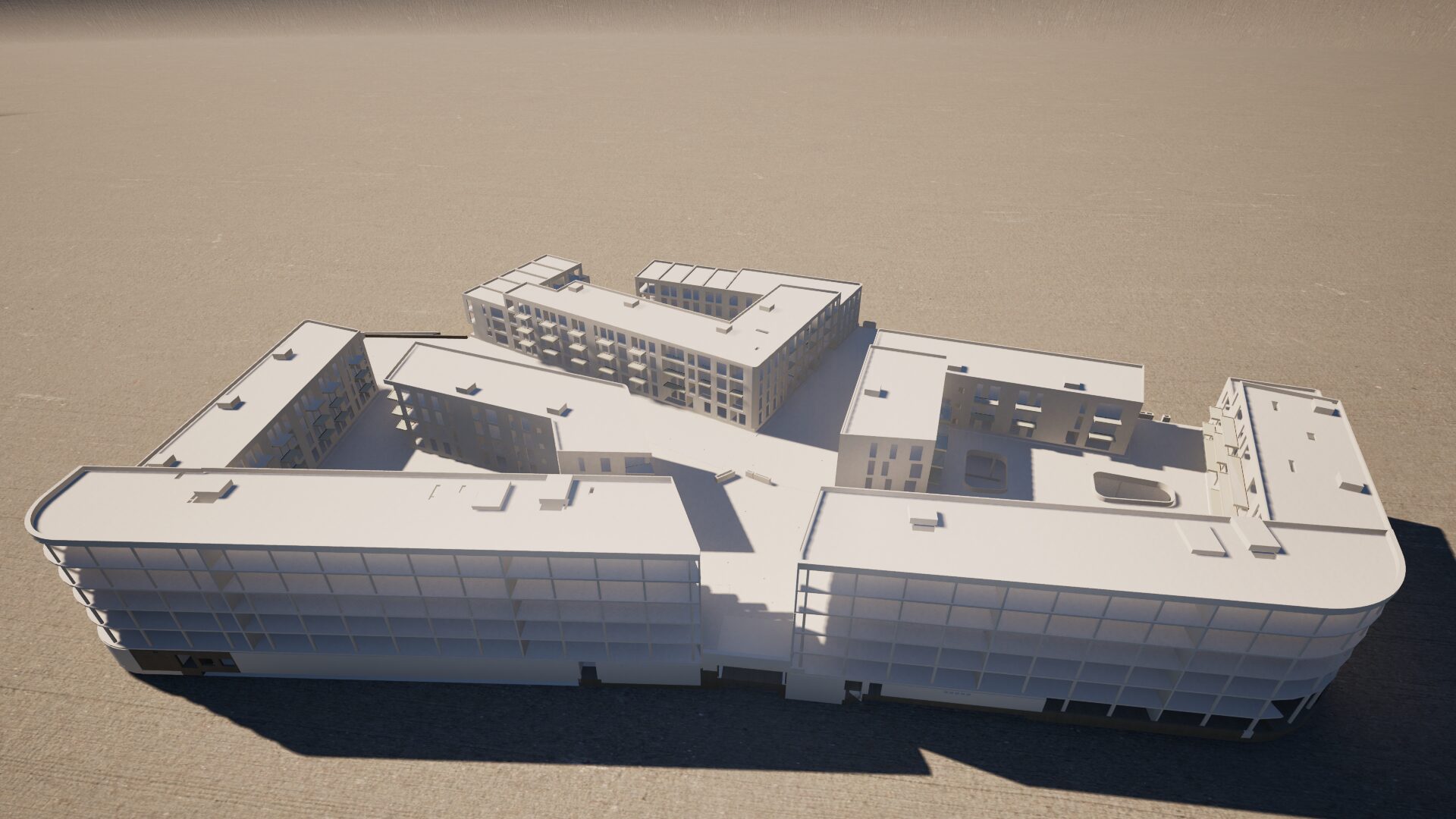
Deiker Höfe is a large residential development in Düsseldorf, Germany, with a total construction area of approximately 55,000 m². The complex is organized into three building zones – A, B, and C – connected by a continuous 16,000 m² underground garage that physically and structurally links the entire site.
Across the three zones the project includes eight residential buildings:
- Zone A: 3 buildings
- Zone B: 3 buildings
- Zone C: 2 buildings
The buildings range from 3 to 6 floors and are designed as reinforced concrete structures. NS Drafter delivered formwork and reinforcement detailing package – slab, wall, column, beam, foundation, and staircase across the eight buildings and the shared garage – over a 9-month window using approximately 12,500 working hours.

The Detailing Challenge on Large Residential Sites
Residential project detailing at this scale is usually misread as repetitive work. Repeated elements keep the workload manageable; unique configurations are where time accumulates. Deiker Höfe is a good example of why:
- Eight buildings with different floor counts means eight distinct vertical stacks of slabs, walls, and columns
- Three zones means three site-coordination layers
- A continuous underground garage under all zones means slab-on-foundation interfaces that change every few meters
In other words, formwork and reinforcement detailing workload has to be planned around two competing pressures: reusing every repeatable detail while keeping the non-repeating interfaces clean and constructible.
For a project located in Düsseldorf and built by a German contractor, that alignment matters in three concrete ways:
- Native bar bending schedule output
- Strong formwork plan generation
- Reinforcement modeling
Scope by Structural Element
Below is the element-by-element scope of the formwork and reinforcement detailing package delivered for Deiker Höfe.
Foundations
Strip and pad foundations under all eight buildings, plus the foundation slab supporting the underground garage. Reinforcement was detailed with full lap, anchorage, and starter-bar coordination for the columns and walls landing on the foundation. Formwork drawings included edge formwork, recesses, and dowel positions.
Walls
Reinforced concrete shear walls for all three zones. Detailing covered both faces of reinforcement, opening trimmings around windows and door penetrations. For a project where walls repeat vertically across up to six floors, wall reuse rules were defined once per typology and reused across the building stack.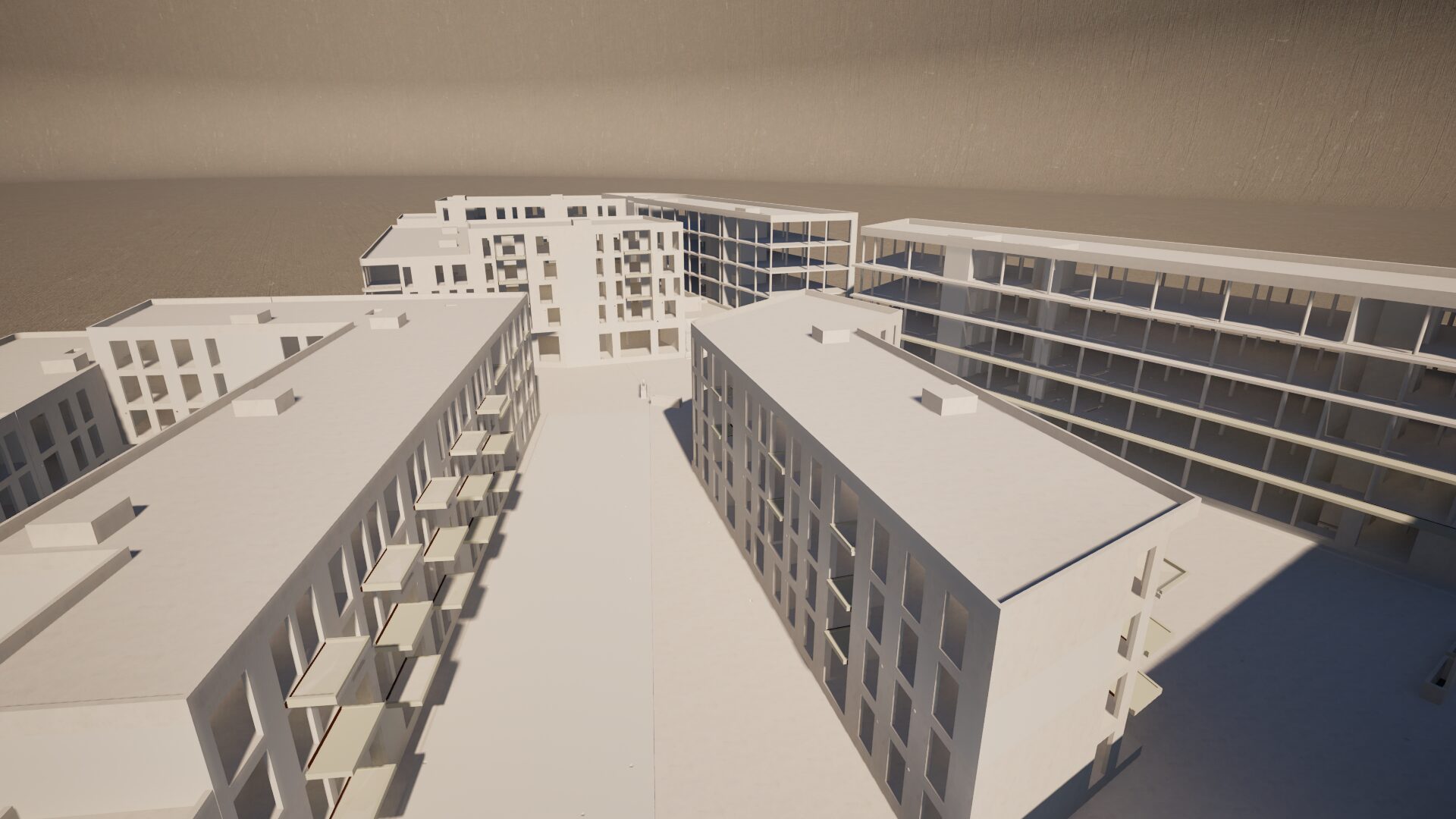
Columns
Internal and perimeter columns across the eight buildings, with reinforcement cages detailed for full height including splice locations at slab levels.
Slabs
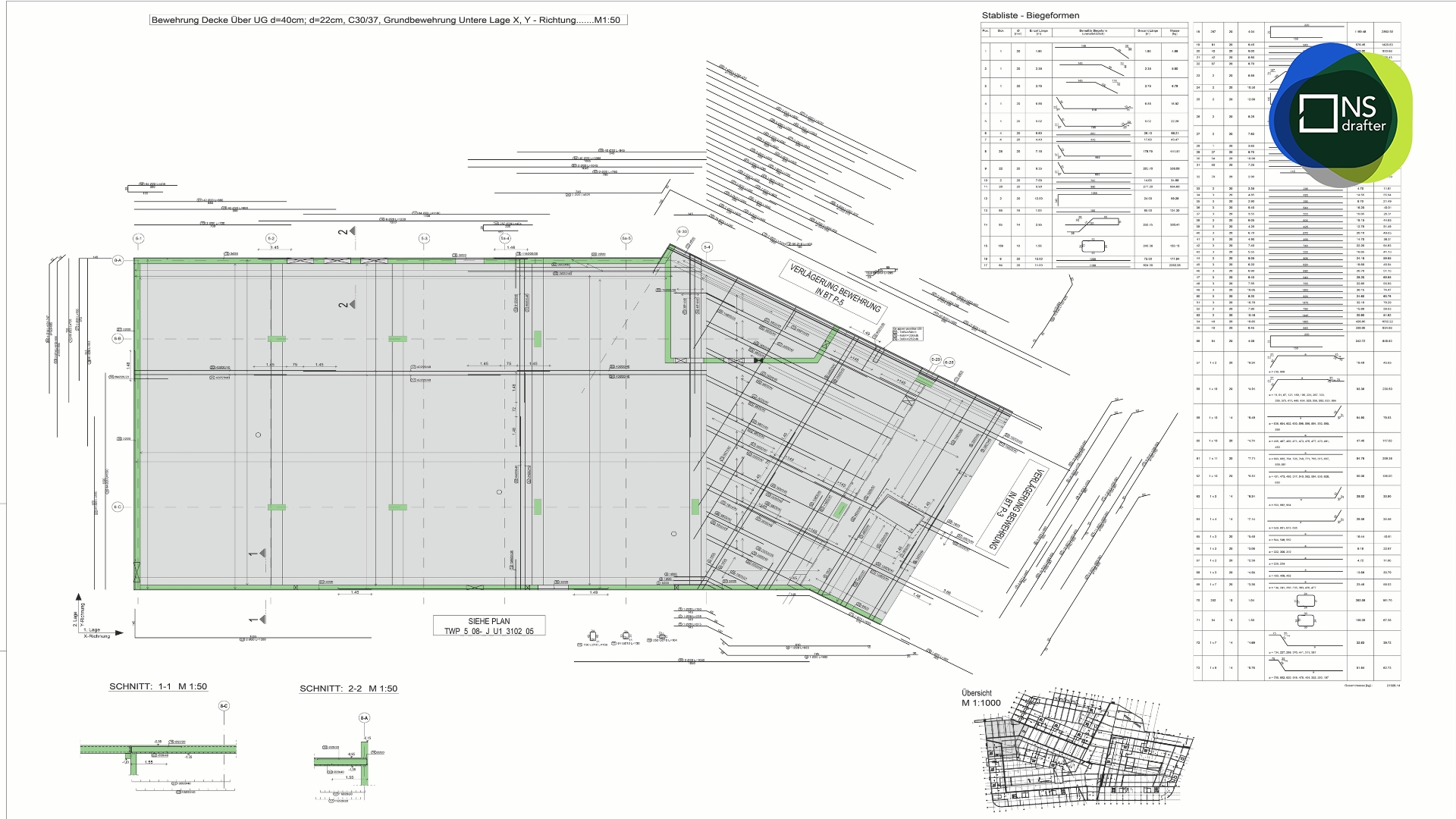
Floor slabs from foundation level to roof level for every building, plus the garage slab. This was the highest-volume part of the reinforced concrete documentation package: top and bottom reinforcement, additional bars over supports, openings, recesses, and balcony cantilever detailing. Slab reinforcement plans were issued per pour zone to match the contractor’s pour sequence.
Beams
Primary and secondary beams where the slab system required them, with full stirrup distribution, top and bottom longitudinal reinforcement, and anchorage detailing into columns and walls.
Staircases
Cast-in-place reinforced concrete staircases in every building. Detailing covered both flights and landings, including bottom reinforcement, distribution bars, and anchorage into landing walls.
The 16,000 m² Underground Garage
From a detailing perspective, underground garage reinforcement detailing has three things going on at once:
- A continuous slab with expansion joints and post-tensioning or heavy mild reinforcement zones that change based on column grid.
- A column forest at relatively tight spacing, where every column carries either a residential tower above or just a roof slab, two very different load cases that produce two very different reinforcement designs.
- Earth-retaining perimeter walls that act as both basement walls and load-bearing elements for the buildings above.
We handled this by treating the garage as the geometric reference for the entire site. Every building’s foundation level was modeled against the garage slab first, then the building was extruded upward. This kept starter-bar positions, joint locations, and slab thicknesses consistent across the eight vertical stacks.
Results and Lessons Learned
The formwork and reinforcement detailing package delivered on Deiker Höfe is now our internal benchmark for residential projects above 50,000 m². The headline numbers:
- 55,000 m² total construction area documented
- 8 buildings detailed, 3 – 6 floors each
- 16,000 m² underground garage detailed as a single coordinated structure
- 12,500 working hours of detailing effort
- 9-month delivery window
- All elements – foundations, walls, columns, slabs, beams, staircases covered
 A few lessons stand out from the project that we now apply to every large-scale residential formwork drawings package:
Plan the reuse before the modeling starts. On a site with eight buildings, the decision about which slabs, walls, and balcony details get treated as “the canonical typology” and which get treated as “variants” is the single biggest driver of the hour count.
Pour zones drive drawing layouts. Reinforcement drawings issued by floor look clean to the engineer but slow the contractor down. Drawings issued by pour zone, even when that splits a single floor into three sheets, are what the site crew actually uses. We aligned every sheet to the contractor’s pour sequence.
The garage is the reference. Treating the underground garage as the geometric backbone removed an entire class of interface errors. On every subsequent large residential project we’ve started with the basement and built upward, both literally and in the modeling environment.
About Us
NS Drafter specializes in BIM modeling, rebar detailing, steel detailing, and construction documentation for residential, commercial, and complex infrastructure projects. Our teams work across Revit, AutoCAD (ArmCAD), Tekla, and Allplan, delivering models and plans depending on project requirements.
Ready to improve your BIM modeling workflow or start your first fully modeled project? Get in touch and let’s talk about where to start.
Our Project Case Studies:
Successful Construction Case Study I Tesla Gigafactory Berlin
Successful Construction Case Study I 55.000 m² in Amsterdam
