
Non-Newtonian Concrete: Essential Facts Detailers Must Know
Introduction
For centuries, construction relied on materials whose behavior was predictable, but also limiting. Concrete in particular has long been handled through rigid rules: how to mix it, how to pour it, how to vibrate it. Advanced rheology, the science of how materials flow, is changing that picture, and non-Newtonian concrete is where the change shows up most clearly.
In this guide we look at what non-Newtonian concrete is, where the idea came from, why segregation is the problem behind it, how the flow is tuned, and what it means for reinforcement and formwork detailing at NS Drafter.
What Is Non-Newtonian Concrete?
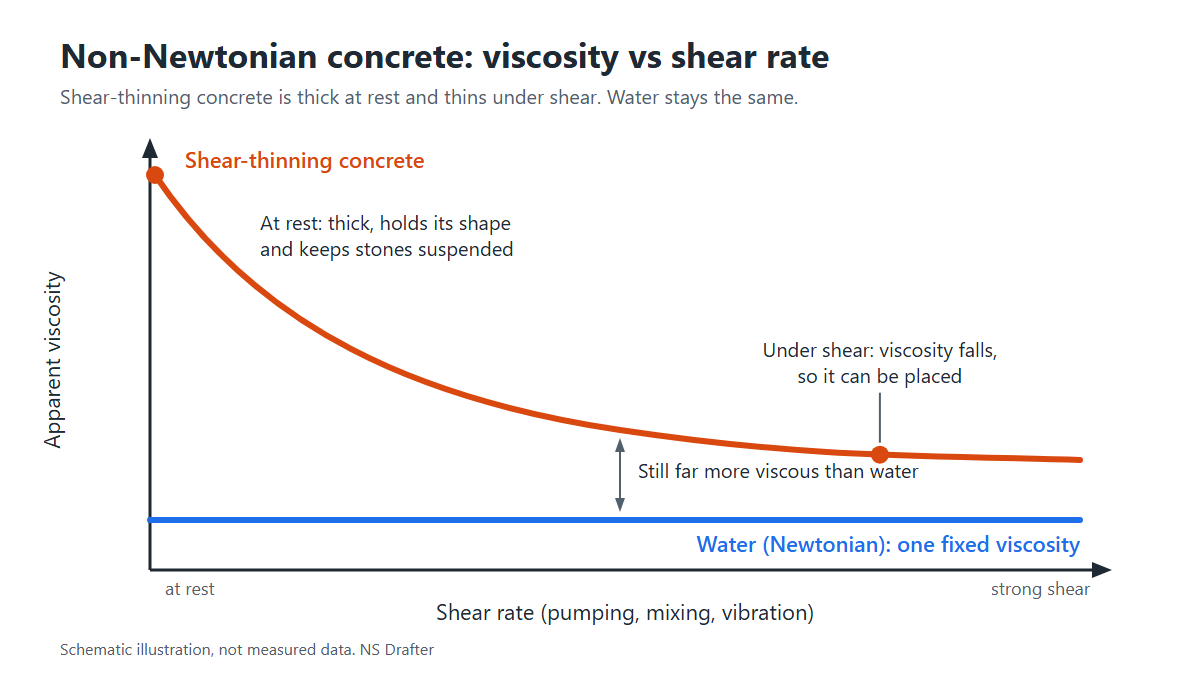
Non-Newtonian concrete is concrete whose viscosity changes with the stress applied to it. At rest it holds its shape in the formwork, and when it is pushed by pumping, mixing or vibration it flows. All fresh concrete behaves this way to some degree, and engineered mixes such as self-compacting concrete make the behavior deliberate.
Think of fresh concrete as a mix of cement paste, sand and stones. Non-Newtonian concrete is therefore not a new product you order from a catalogue. What has changed over the last decades is how precisely engineers can design that behavior.
For a detailer, non-Newtonian concrete is more than academic vocabulary. The way it flows decides how it fills congested joints, how hard it pushes on formwork and which assumptions belong on the drawings.
What Is Concrete Segregation and Why Does It Matter?
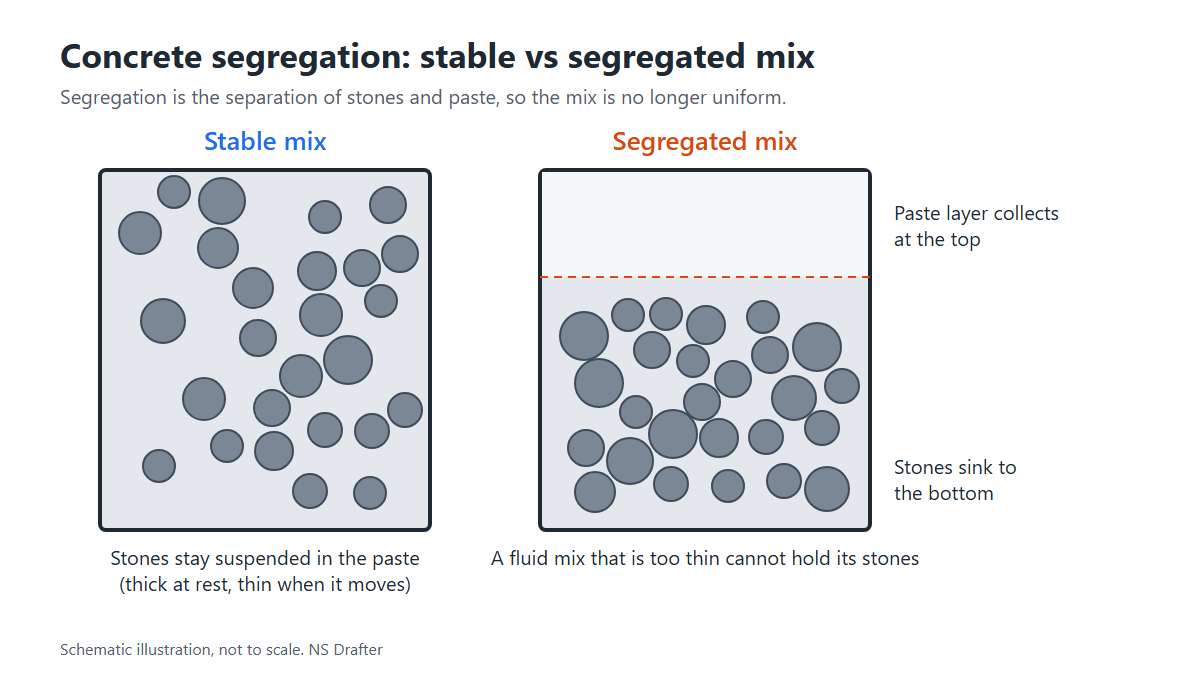
Segregation is the separation of concrete into its parts: heavier stones sink while the cement paste rises toward the surface, so the mix is no longer uniform. It is the main risk that every fluid mix has to manage, which is why it sits at the center of non-Newtonian concrete design.
How Did Extra Water Cause Segregation?
On site, the old shortcut for getting concrete into complicated formwork or around dense reinforcement was to add water. The paste became thinner, and the stones had an easier time sinking through it.
The physics is simple. A construction magazine explanation of self-compacting concrete uses Stokes’ law to show that settling risk falls when the liquid is more viscous, the particles are smaller, or the density difference between particles and liquid is smaller. Added water thins the paste, which pushes in exactly the wrong direction.
What Is the Difference Between Static and Dynamic Segregation?
Researchers describe two kinds of stability. According to a research summary in the Concrete Answers series, dynamic stability is resistance to separation during movement, such as mixing or placement, and static stability is resistance to bleeding and segregation after casting until the concrete hardens.
The same source describes how static stability is checked: a probe measures the layer of mortar or paste that collects at the top of fresh SCC, and a thicker layer means lower stability. It also lists common static tests such as the visual stability index, the column segregation test (ASTM C 1610), the V-funnel and a penetration apparatus. It notes that a reliable method for dynamic segregation is still needed. That page is a 2011 research summary, so newer test methods may exist.
Why Is Self-Compacting Concrete More Exposed?
The more fluid a mix, the harder stability becomes. The same Concrete Answers page says that the high flowability of SCC makes it much more susceptible to stability problems than normal concrete.
This is where non-Newtonian concrete behavior earns its place. The ideal mix is thick while at rest, so the stones stay suspended, and thin while moving, so it can be pumped and placed. The Construction Canada article describes a viscosity-modifying admixture as one that increases viscosity at rest but allows lower viscosity when flowing. It also links the extra stiffness that thixotropy builds at rest, together with enough viscosity, to resistance against segregation.
How Do Mix Designers Keep the Balance?
According to the same article, mix designers work inside a window plotted from slump flow and flow time. Two levers do most of the work for a well-graded aggregate. The dosage of high-range water reducer mainly affects slump flow, and the “thickness” of the mix mainly affects flow time. Thickness can be raised by using less water and coarse aggregate, more cementitious material and fine aggregate, or a viscosity-modifying admixture.
A detailer cannot fix segregation of non-Newtonian concrete in a model. It is a mix design and placement problem. What a detailer can do is ask whether stability was tested, and flag that question before drawings are issued.
How Do Superplasticizers Control Concrete Flow?
Polycarboxylate ether (PCE) superplasticizers adsorb on cement particles and break up the clumps between them, which keeps the particles dispersed and the mix flowing. This is the main tool for adding flow to non-Newtonian concrete in self-compacting mixes. Flow without stability invites segregation, so the dosage has to be balanced as described above.
For the far end of mix design, where coarse aggregate is removed entirely, see our guide to ultra-high performance concrete (UHPC).
Why Is a Superplasticizer Not a Simple Flow Switch?
In cement slurry, particles tend to clump into a flocculated structure. In a 2024 study of EPEG-based PCEs, the authors explain that adsorbed PCE alters the particle surface, breaks up the flocculated structure and keeps the particles evenly dispersed.
Side-chain design complicates the picture. Earlier studies the paper cites reach opposite conclusions on side-chain length: some report that shorter chains adsorb more slowly but give better dispersion stability, while longer chains can speed hydration and worsen flow retention. The authors attribute this to differences in copolymer composition.
The behavior of non-Newtonian concrete therefore belongs to a specific mix, not to an admixture category. For a detailing team, a brochure claim is not design data: ask for the mix design assumptions and trial results the designer relied on.
What Does Non-Newtonian Concrete Mean for Rebar and Formwork Detailing?
Rheology does not change what the model has to show, but it changes what the detailer should ask the project team. Two questions matter most: how much room the bars leave for the aggregate, and what pressure the formwork is designed for.
Can You Tighten Bar Spacing With Self-Compacting Concrete?
No. Bar spacing limits come from the design code, and the mix has to suit the gaps the detailer leaves. A mix that flows well does not make a tight bar layout acceptable.
Eurocode 2 is explicit about spacing. The Concrete Centre’s detailing table lists the minimum bar spacing under clause 8.2(2) as dg + 5 mm, or bar diameter, or 20 mm. Which of these values governs, and any National Annex change, must be confirmed against EN 1992-1-1 for each project country.
ACI 318 links aggregate size to bar spacing from the other direction. Under ACI 318-19 section 26.4.2.1(a)(5), the nominal maximum size of coarse aggregate may not exceed the least of one-fifth the narrowest dimension between form sides, one-third the slab depth, and three-fourths the minimum specified clear spacing between bars. The same page says these limits do not apply if the licensed design professional judges that the concrete can be placed without honeycombs or voids. That judgment belongs to the engineer, not the detailer.
The detailing question is therefore: what maximum aggregate size is the mix designed for, and does the bar layout leave room for it?
Does Self-Compacting Concrete Always Load Formwork at Full Hydrostatic Pressure?
Not necessarily. The paper “Influence of the Rheological Properties of SCC on the Formwork Pressure” by Drewniok, Cygan and Gołaszewski (Procedia Engineering, 2017) states that SCC formwork is commonly designed on the assumption of full hydrostatic pressure, yet the design pressure could be reduced if rheological properties are taken into account.
The study treated fresh concrete as a fluid with a yield stress (a Bingham fluid) and presented correlations between static and dynamic yield stress and lateral pressure. The test element was a 1.20 m high column-imitating form cast at 1 and 7 m/h, and the authors report a correlation between rheological parameters and pressure reduction over time.
That does not mean a detailer should reduce formwork loads. It is one laboratory study. It does show that pour rate and mix properties both matter, so the pour rate, the mix and the pressure assumption should be stated on the formwork drawings and agreed with the contractor and the designer.
Which Tools Do We Use?
In Tekla Structures and Allplan, spacing checks, congestion reviews and clash detection are where this knowledge shows up. A model that flags tight bar clusters early gives the project team time to confirm aggregate size, adjust the layout or split a pour. Repeatable detailing logic also helps, see our guide to Tekla custom components.
NS Drafter Experience
At NS Drafter we detail reinforcement for projects where congestion and constructability decide whether a drawing set works on site. The practical habit is to treat concrete behavior as input data: ask for the mix assumptions, record them in the model notes and check spacing against the code, not against how workable the mix is claimed to be.
For the wider picture of getting models to a build-ready state, see our guide to a fabrication-ready reinforcement model and our look at sustainable rebar detailing.
Common Myths About Non-Newtonian Concrete
Because non-Newtonian concrete attracts hype, a few misunderstandings are worth clearing up. Each one has direct consequences for how drawings are prepared and checked.
Myth 1: Non-Newtonian concrete breaks the laws of physics. It does not. Fresh concrete is routinely modeled with ordinary rheology, for example as a fluid with a yield stress in formwork-pressure research. The physics is standard. The mix design is what is sophisticated.
Myth 2: The more fluid the non-Newtonian concrete, the better. Viscosity falls under shear, but it never drops to the level of water, and a thinner mix is not automatically a better one. Very high flowability makes SCC much more susceptible to stability problems than normal concrete, so flow has to be balanced against stability.
Myth 3: It allows tighter bar layouts. Code spacing limits still govern, and ACI 318 even ties the maximum aggregate size to the clear spacing between bars. A flowing mix is a placement advantage, not a design allowance.
Myth 4: One superplasticizer behaves like the next. Research on PCE side chains shows that dispersion depends on polymer structure, so the performance of non-Newtonian concrete has to be confirmed for the actual mix.
Conclusion
Non-Newtonian concrete represents a perfect combination of fluid physics, polymer chemistry, and advanced civil engineering.
By pushing the boundaries of how fresh concrete behaves under pressure, this material has overcome long-standing placement challenges, opened the door to previously unimaginable architectural forms, and laid the foundation for future technologies such as 3D-printed buildings.
For companies focused on the digital future of construction, such as NS Drafter, understanding and implementing these material properties through BIM and RC detailing is not just an option – it is a key step towards creating smarter, safer, and more efficient structures that will shape the world of tomorrow.
FAQ
What is segregation in concrete?
Segregation is the separation of heavy stones from the cement paste in fresh non-Newtonian concrete, so the mix is no longer uniform. It can happen while the concrete moves (dynamic) or after casting while it is still fresh (static).
Why is segregation a bigger risk with self-compacting concrete?
Because the mix is very fluid. According to the Concrete Answers research summary, high flowability makes SCC much more susceptible to stability problems than normal concrete, so the mix must be thick at rest and thin in motion.
What is the difference between non-Newtonian concrete and self-compacting concrete?
Non-Newtonian describes how concrete flows. Self-compacting concrete is a mix designed to flow and compact without vibration. SCC relies on controlled non-Newtonian behavior, but the terms are not interchangeable.
Does self-compacting concrete allow closer bar spacing?
No. Eurocode 2 and ACI 318 spacing rules still apply, and they relate bar spacing to bar diameter and aggregate size. Check the project’s design code and National Annex.
Does SCC always load formwork with full hydrostatic pressure?
Not necessarily. Formwork is often designed for full hydrostatic pressure, but research indicates the design pressure could be reduced when rheological properties are considered. Any reduction should come from the designer and contractor, not the detailer alone.